Views: 0 Author: Site Editor Publish Time: 2026-04-12 Origin: Site
Section | Summary |
Motherboard Form Factors | An overview of standardized dimensions like ATX, Mini-ITX, and 3.5-inch boards, explaining how size impacts cooling and expansion. |
Choosing the Right Board | A deep dive into the selection criteria including chipset longevity, power input requirements, and environmental resistance. |
Industrial Motherboard + Industrial Chassis | Exploring the synergy between the internal motherboard and the protective enclosure to create a complete industrial computer system. |
Industrial Motherboards and SBCs | A technical analysis of high-performance boards and Single Board Computers designed for specialized industrial applications. |
Industrial Rugged Edge Computers | Examining how the motherboard integrates into fanless, ruggedized systems for deployment in the harshest outdoor or factory floor environments. |
The motherboard form factor is the foundational physical specification that determines the dimensions, mounting hole locations, and power supply type of the hardware, ensuring compatibility with various industrial enclosures and thermal management systems.
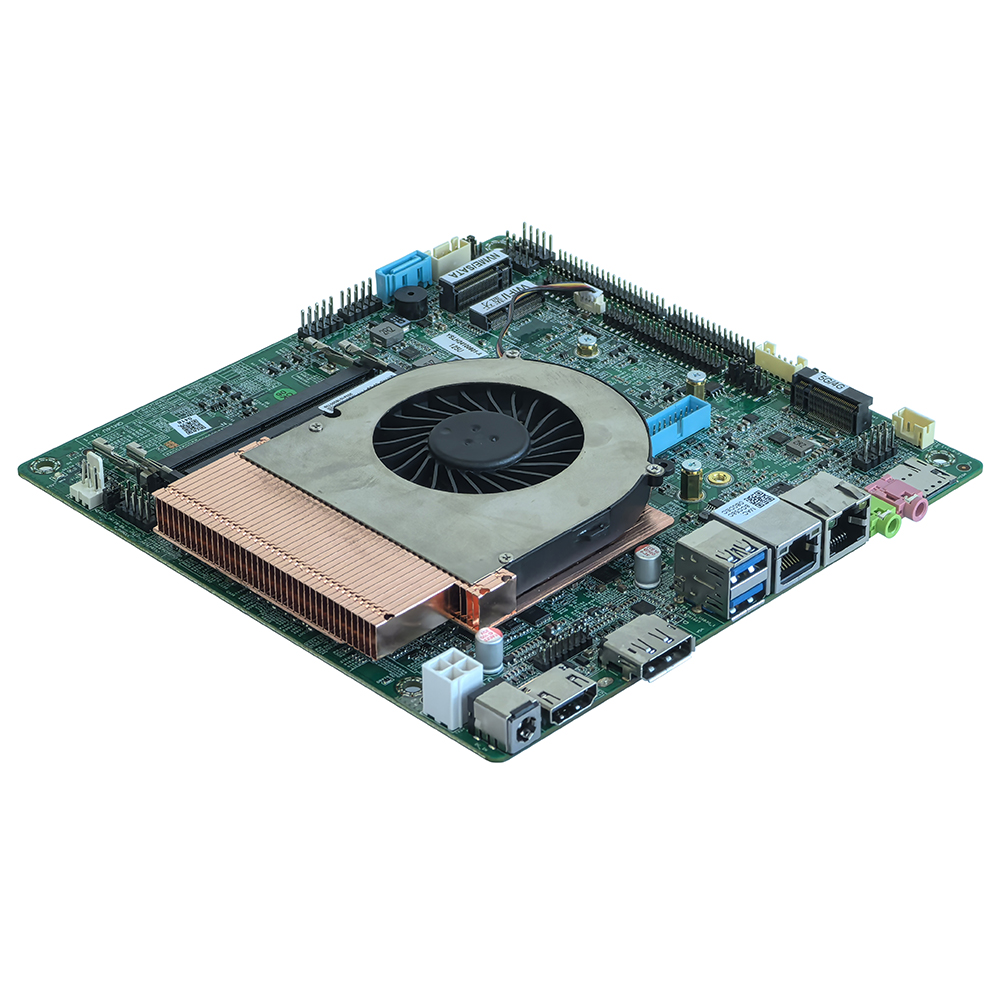
When selecting a motherboard for industrial use, the physical footprint is often the first constraint. Standard ATX boards are common in server-room environments where space is plentiful, providing numerous PCIe slots for high-end GPU or FPGA integration. However, in modern smart factories, space is at a premium. This has led to the rise of the Mini-ITX motherboard, which measures just 170mm by 170mm. These boards offer a balanced middle ground, providing enough surface area for a powerful CPU and essential I/O while fitting into compact wall-mounted cabinets.
Further down the scale are the highly specialized small form factors, such as the 3.5-inch Single Board Computers. These are not just smaller versions of a standard motherboard; they are engineered for "headless" or embedded operations where every millimeter counts. These boards often feature soldered-on processors to improve vibration resistance and reduce the height profile of the system. Their layout is optimized for fanless cooling, allowing the entire chassis to act as a heat sink.
The choice of form factor also dictates the expansion potential of the motherboard. For example, an industrial deployment requiring multiple frame grabber cards for machine vision will necessitate an ATX or Micro-ATX motherboard with multiple PCIe x16 or x8 slots. Conversely, a digital signage controller or a simple PLC gateway might only require a 3.5-inch motherboard with integrated COM ports and dual LAN, prioritizing a small footprint over modularity.
ATX (12" x 9.6"): Maximum expansion, ideal for high-end servers and complex vision systems.
Micro-ATX (9.6" x 9.6"): A balanced approach for medium-sized control units.
Mini-ITX (6.7" x 6.7"): The standard for compact industrial PCs and kiosks.
3.5" SBC (5.8" x 4.0"): Ultra-compact, often used in embedded automation and robotics.
Choosing the right motherboard requires a practical evaluation of the application environment, product lifecycle needs, system performance, and the specific I/O interfaces required for communication, control, and expansion.
A reliable motherboard should support stable operation across different use scenarios, rather than being limited to one narrow category. In many projects, the same board may be used in automation equipment, commercial terminals, edge computing devices, digital signage, self-service machines, security systems, or other embedded applications. For buyers, the key point is not whether the motherboard is strictly labeled as consumer-grade or industrial-grade. What matters more is whether it offers the right interface layout, stable component selection, suitable performance, and long-term supply support for the target device.
Environmental adaptability is also important. Elsky motherboards normally support operation from -10°C to 60°C, which can meet the needs of many indoor equipment, commercial systems, light industrial devices, and embedded computing applications. In addition, stable power input, suitable thermal design, and reliable component matching help the motherboard maintain consistent performance during long working hours. This is especially useful for equipment that needs to run continuously in retail, factory, logistics, medical, transportation, or public-service environments.
The I/O configuration on an application-ready motherboard should match the way the final system communicates with external devices. Depending on the project, buyers may need LAN ports, USB interfaces, display outputs, COM ports, GPIO, or other expansion options. These interfaces allow the motherboard to connect with sensors, displays, control modules, payment devices, network equipment, and peripheral hardware. A well-matched motherboard can help system builders reduce redesign work, simplify integration, and support a wider range of application industries.
Thermal Design: Presence of oversized heat sinks or support for fanless thermal dissipation.
Expansion Options: Availability of Mini-PCIe or M.2 slots for Wi-Fi, 4G/5G, or AI acceleration modules.
Watchdog Timer: A specialized circuit on the motherboard that automatically reboots the system if the software freezes, ensuring 24/7 uptime.
The integration of a specialized motherboard into a ruggedized industrial chassis creates a complete industrial computer system designed to withstand dust, moisture, and mechanical shock while maintaining optimal internal temperatures.
A motherboard cannot survive the factory floor alone; it requires a chassis that complements its technical strengths. The relationship between the motherboard and the chassis is symbiotic. For instance, a fanless motherboard design relies on a chassis with extruded aluminum fins that draw heat away from the CPU via copper heat pipes. This "Industrial Computer" configuration eliminates the need for internal fans, which are often the first component to fail in dusty environments.
The mechanical design of the chassis must align perfectly with the motherboard I/O shield. In industrial settings, this often includes specialized "Lockable USB" ports or M12 connectors that prevent cables from being pulled out by vibration. Because the motherboard might be mounted on a DIN rail or a VESA mount, the chassis must provide the necessary structural integrity to protect the delicate PCB of the motherboard from flexing or cracking under mechanical stress.
Furthermore, the combination of a high-performance motherboard and a shielded chassis provides essential Electromagnetic Compatibility (EMC). Factories are filled with high-voltage equipment that generates significant electrical noise. A properly grounded industrial motherboard inside a metal chassis ensures that data signals remain clean and that the system does not interfere with other sensitive electronics nearby. This holistic approach to hardware ensures that the motherboard performs at its peak without external interference.
Dust Protection: Fanless chassis prevent the buildup of conductive dust on the motherboard surface.
Vibration Resistance: Secure mounting points for the motherboard and internal components like RAM and SSDs.
Ease of Installation: Standardized mounting options like DIN-rail or wall-mount kits.
Cable Management: Internal headers on the motherboard allow for clean routing to external bulkhead connectors.
Industrial motherboards and Single Board Computers (SBCs) represent high-density computing solutions that integrate all essential functions—CPU, memory, and I/O—onto a single PCB to maximize reliability and minimize the system footprint.
The distinction between a standard motherboard and an SBC is vital for system integrators. An industrial motherboard typically follows standard form factors like Mini-ITX, allowing for some modularity. In contrast, an SBC often integrates the processor directly onto the board (BGA packaging). This integration is a strategic choice for industrial applications because it eliminates the socket as a potential point of failure during high-vibration events, such as those found in mobile robotics or rolling stock.
Modern industrial motherboard designs often leverage low-power architectures like Intel Atom, Celeron, or Core i-series (U-series) to keep the Thermal Design Power (TDP) low. A low-TDP motherboard is easier to cool and requires less power, which is essential for remote deployments running on solar or battery power. Despite the low power consumption, these boards do not sacrifice connectivity; a high-quality 3.5-inch motherboard can still support dual 4K displays via HDMI or DisplayPort, catering to complex HMI (Human Machine Interface) applications.
Technical specifications for these boards often include specialized support for "Always-On" functionality. The BIOS/UEFI on an industrial motherboard usually includes options for "Auto Power On" after a power failure, ensuring that the system resumes operation without human intervention. This makes the motherboard ideal for unattended kiosks, smart lockers, and remote environmental monitoring stations.
Feature | Industrial Motherboard (Mini-ITX) | Industrial SBC (3.5 inch) |
CPU Mounting | Socketed (LGA) or Soldered (BGA) | Almost always Soldered (BGA) |
Expansion | 1x PCIe Slot + M.2 | M.2 / Mini-PCIe only |
Power Input | 24-pin ATX or 12V DC | Wide Range DC (9-36V) |
Typical Use | Workstations, High-end HMI | Embedded Sensors, Gateway, Robotics |
Industrial rugged edge computers are the pinnacle of motherboard engineering, where the motherboard is specifically designed to process data at the "edge" of the network, providing real-time analytics in environments where traditional computers would fail.
At the "Edge," the motherboard serves as the primary engine for data processing, reducing the need to send massive amounts of raw data to the cloud. A rugged edge motherboard is often equipped with specialized AI acceleration slots (such as M.2 for TPU or VPU modules). This allows the motherboard to handle complex tasks like facial recognition, defect detection on a production line, or predictive maintenance algorithms locally and instantaneously.
The "Rugged" aspect refers to the enhanced survivability of the motherboard. These boards undergo rigorous testing for shock and vibration. The design of the motherboard traces, the thickness of the PCB, and the selection of every resistor are optimized to prevent micro-fractures.
Finally, connectivity is a major focus for any edge-based motherboard. Beyond standard Ethernet, these boards often feature multiple SIM card slots and antenna headers for 5G and Wi-Fi 6 connectivity. This ensures that even if one network goes down, the motherboard can switch to a backup path to maintain communication with the central management system. The fusion of high-performance computing, extreme durability, and advanced connectivity makes the rugged edge motherboard the most critical component in modern industrial digital transformation.
Smart Transportation: Managing traffic light synchronization and vehicle-to-infrastructure (V2X) communication.
Automated Warehousing: Controlling Autonomous Mobile Robots (AMRs) with real-time path planning.
Energy Management: Monitoring power grid stability and managing distributed energy resources.
Security and Surveillance: Running edge-based video analytics for perimeter security in remote areas.