+86-13145827500 Charlie@elskyipc.com

Views: 0 Author: Site Editor Publish Time: 2026-08-26 Origin: Site
Network architecture drives edge computing success. Latency, uptime, and security remain non-negotiable in remote deployments. You must build systems capable of surviving harsh conditions while maintaining constant communication. Consumer marketing often pushes dual ethernet as a flashy gimmick for gamers. Industrial reality tells a drastically different story. True network redundancy and strict IT/OT isolation dictate whether your hardware survives or fails on the factory floor. Relying on standard consumer boards risks catastrophic downtime and severe security breaches. This article serves as your definitive buyer’s framework. You will learn how to evaluate and shortlist the right hardware for specific edge workloads. We explore form factors, controller selection, and crucial deployment realities to help you make informed engineering choices.
Dual LAN at the edge is primarily for physical network segmentation (IT vs. OT) and failover, not consumer-style link aggregation.
Form factor dictates deployment flexibility; a Mini-ITX industrial motherboard offers the best balance of expansion and compact footprint for edge enclosures.
High-throughput edge tasks (like machine vision) require specific complementary specs, such as an M.2 NVMe motherboard architecture and robust I/O.
Selecting the right Ethernet controller chip (e.g., Intel vs. Realtek) is critical for software compatibility (e.g., pfSense, custom Linux kernels).
Many people view dual ethernet ports as an unnecessary luxury. We must debunk this gimmick myth immediately. Two network interfaces might be overkill for standard desktop PCs. However, they represent a hard requirement for industrial continuity. Implementing a dual LAN industrial motherboard fundamentally changes how you manage local data routing.
Network isolation stands as the primary technical driver. Industrial facilities divide their networks carefully. You use Port 1 exclusively for the internal machine or sensor network. This represents the operational technology (OT) side. You dedicate Port 2 strictly to secure cloud or external communication. This represents the information technology (IT) side. Segmenting traffic this way effectively turns the system into an edge gateway motherboard. It builds a robust hardware-level firewall. External threats cannot easily bridge into your sensitive production equipment.
Failover and redundancy add another critical layer of protection. Remote edge environments often present hard-to-access maintenance challenges. You face physical port damage. Sudden network cable degradation happens frequently in high-vibration areas. Dual ports mitigate this risk by providing an immediate backup link. If one line drops, the system seamlessly routes critical alerts through the second line.
Bandwidth allocation also improves significantly under a dual-port architecture. You can dedicate specific ports to high-traffic local processes. High-definition IP camera feeds can run continuously on one gigabit port. Outbound telemetry data runs smoothly on the second port. The local video traffic never chokes the critical sensor data. You maintain perfect data flow across the entire facility.
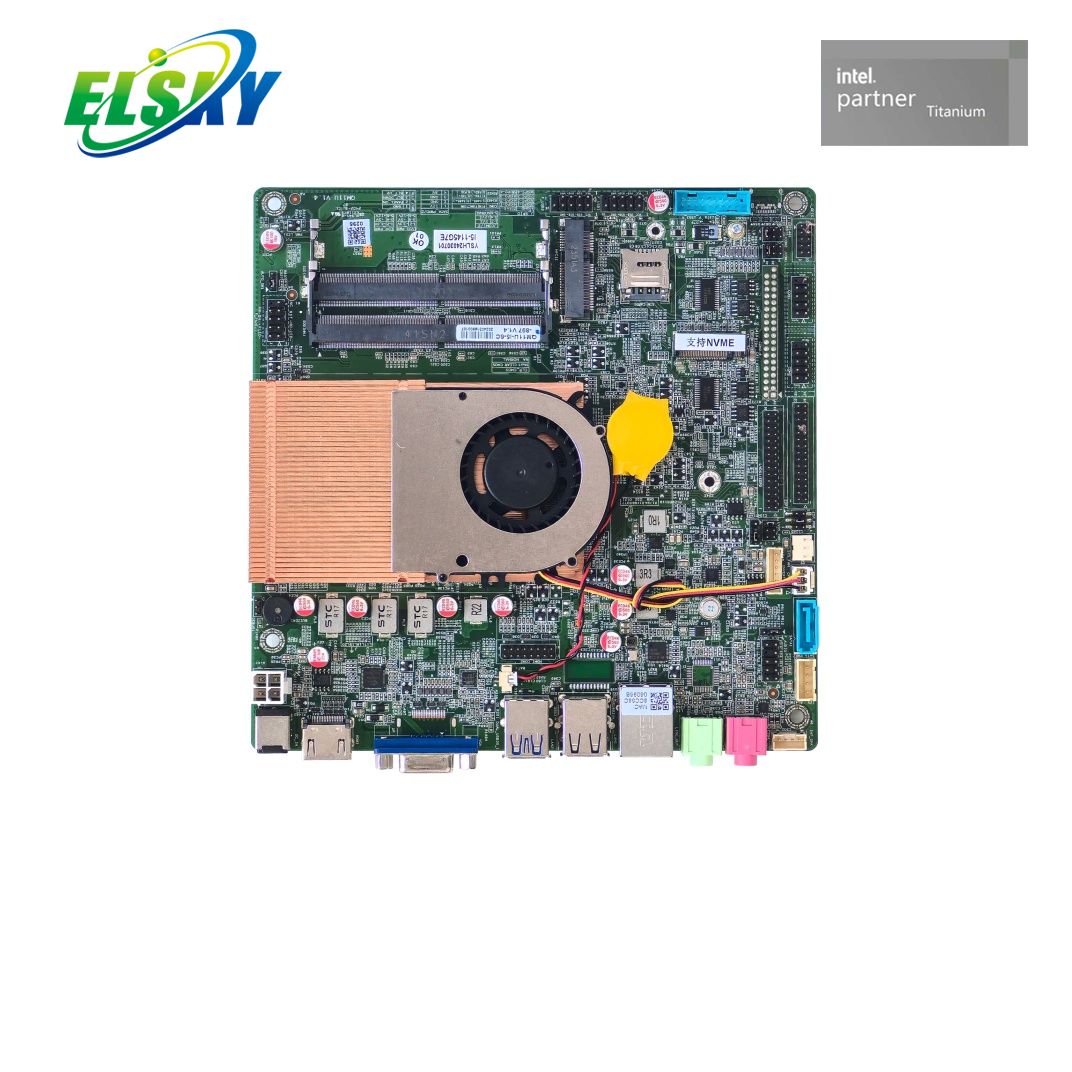
Space and footprint limits dictate your hardware choices heavily. Edge computing happens in incredibly tight spaces. You find systems stuffed into small control cabinets and outdoor weather-proof enclosures. You must evaluate standardized industrial sizes carefully before designing a chassis. A Mini-ITX industrial motherboard serves as the gold standard here. Measuring exactly 170mm by 170mm, it offers the ideal balance. You get a compact footprint alongside necessary PCIe expansion slots. You can easily fit it into fanless, ruggedized chassis without sacrificing performance.
Thermal management risks destroy standard consumer boards rapidly. Edge deployments almost always lack active climate control. You need hardware built explicitly for wide-temperature ratings. True industrial boards operate safely between extreme freezing and boiling temperatures. Fanless cooling support prevents mechanical breakdowns. Dust, metal shavings, and chemical vapors destroy spinning fans quickly. Consumer boards rely heavily on this active cooling. They fail predictably when deployed on dirty factory floors.
Consider I/O placement heavily before purchasing your final hardware. You must look at rear versus front-facing LAN ports. Your specific deployment reality dictates the best physical layout. DIN-rail setups require specific cable management approaches to save cabinet depth. Rack configurations and flush wall-mount enclosures need easily accessible front ports. Bad port placement leads to bent cables. Over time, tension breaks the physical RJ45 connectors.
Choosing the right silicon matters immensely for network stability. You must decide carefully between Intel and Realtek network controllers. Engineers heavily prefer Intel NICs for demanding edge computing environments. Models like the Intel i210, i225, and i226 provide superior driver stability. They integrate seamlessly into custom Linux kernels without requiring manual patches. Software firewalls like pfSense and OPNsense run flawlessly on Intel hardware. Realtek chips serve consumer needs well but sometimes struggle under continuous heavy packet loads. They may experience dropped packets when processing millions of tiny sensor inputs.
Speed requirements dictate your chip selection too. Basic temperature or pressure telemetry data works perfectly fine on standard 1GbE ports. However, dense IoT sensor data requires much more throughput. Machine learning models at the edge consume massive datasets. You should consider 2.5GbE or 10GbE options for these advanced scenarios. High-speed networking prevents critical data bottlenecks at the local node.
Edge computing demands incredibly rapid local data caching. Systems gather massive amounts of raw data from connected sensors continuously. They must process, filter, and cache this data before cloud transmission. Slow storage drives cripple the entire operation and cause software timeouts.
You must prioritize an M.2 NVMe motherboard for these intensive workloads. NVMe drives connect directly to the high-speed PCIe bus. They bypass the slower SATA controllers entirely. This architecture prevents storage bottlenecks when writing simultaneous data streams. This setup also dramatically improves operating system boot resilience. Fast recovery times keep your remote nodes online. They boot back up in seconds after sudden power losses.
Machine vision integration represents a massive growing edge requirement. Automated quality control relies on edge nodes handling local image processing. Modern factories use them to spot microscopic defects on assembly lines. They also power complex digital signage and human-machine interfaces. You need specific visual hardware outputs alongside your dual networking.
This scenario highlights the absolute necessity of a 4K embedded motherboard. High-resolution image processing requires perfectly reliable display outputs. You should look for native HDMI, DisplayPort, or internal LVDS connections. Integrating these visual outputs alongside dual LAN ports is crucial. It ensures the board handles heavy automation tasks and operator displays effortlessly.
Every engineering project carries inherent physical and software risks. Dual LAN introduces very specific network bridging vulnerabilities. Connecting two distinct networks creates potential backdoors for malware. You must implement strict software firewall policies immediately. Avoid accidental network loopbacks during initial setup and testing. A physical loopback crashes the entire local switch immediately.
Power delivery reliability demands your focused attention. Power over Ethernet (PoE) simplifies edge installations dramatically. It combines power and data into a single cable. You must ask whether the board supplies PoE directly. Can it drive connected edge cameras natively? Sometimes you need external managed PoE switches. Internal power delivery reduces overall cable clutter. However, it generates extra heat inside the fanless chassis. You must balance these thermal tradeoffs carefully.
Lifecycle and availability separate true industrial gear from consumer electronics. Commercial motherboards typically feature a very short one-year market lifecycle. You should never deploy these in long-term engineering projects. Finding identical replacement parts becomes mathematically impossible later.
Common Edge Deployment Mistakes:
Deploying standard consumer desktop boards inside hot, unventilated smart factory cabinets.
Ignoring vendor supply guarantees during the early prototype phase.
Assuming mounting hole patterns will remain identical across future consumer hardware generations.
Failing to test driver compatibility with specific real-time operating systems.
Evaluate your vendors strictly for extended long-term supply guarantees. True industrial hardware manufacturers guarantee a five-to-seven-year availability timeline. You secure your supply chain firmly by verifying this upfront.
Comparison Chart: Standard vs. Industrial Dual LAN Deployments
Feature | Standard Consumer Board | Industrial Dual LAN Board |
|---|---|---|
Network Purpose | Gaming optimization, basic teaming | IT/OT separation, strict failover |
Lifespan Guarantee | 12 to 18 months maximum | 5 to 7 years typical |
Thermal Design | Requires active fan cooling | Supports fanless, wide-temp ranges |
Controller Preference | Often cost-optimized (Realtek) | Stability-optimized (Intel i210/i226) |
You must identify your core application before writing a purchase order. Hardware needs vary wildly across different edge computing environments. Applying a rigid logic framework prevents costly procurement mistakes.
Follow this structured shortlisting process:
If building a network firewall or router: Prioritize Intel NICs for ultimate kernel stability. Select low-power processors to minimize heat generation in small telecom cabinets.
If building a factory industrial controller: Prioritize rich legacy COM ports alongside the isolated LAN interfaces. Choose rugged, surface-mounted components designed for high vibration environments.
If building an automated vision system: Prioritize a high-end 4K-capable board. Ensure it features high-speed NVMe storage slots and extra PCIe expansion for dedicated AI accelerator cards.
The next critical steps involve rigorous hardware verification. Engineers and procurement teams must request detailed technical datasheets from the manufacturer. You should verify operating system kernel compatibility as early as possible. Always order an evaluation unit for proof-of-concept (PoC) testing. Never deploy an untested board layout directly into a live production environment. PoC testing reveals hidden thermal throttling issues. It exposes driver conflicts long before they cause massive factory downtime.
Choosing a dual-LAN board for the edge requires careful engineering analysis. It involves much more than simply plugging in two network cables. You secure hardware reliability and ensure strict network security by making the correct architectural selection.
Understand your specific edge workload clearly to determine necessary network speeds and controller types.
Prioritize physical network segmentation to protect critical internal machinery from external internet threats.
Select form factors and passive cooling methods suited for extreme environmental conditions.
Always insist on extended long-term supply guarantees to protect your ongoing deployment lifecycle.
We highly encourage you to consult with an industrial hardware specialist today. Browse our specific catalog of purpose-built edge motherboards to secure a deep technical consultation for your next major project.
A: Intel controllers provide significantly better native driver support across Linux and FreeBSD systems. They handle heavy, continuous packet loads with much lower CPU overhead. Engineers heavily prefer them for their proven stability in 24/7 routing and firewall applications like pfSense.
A: Yes, you can use LAG if your connected network switch supports the 802.3ad protocol. However, link aggregation remains rare in edge deployments. Network failover and strict IT/OT separation provide far more value. They represent the standard practice in industrial computing.
A: You do not strictly need one, but experts highly recommend it. Fanless designs eliminate moving parts, removing the most common mechanical point of failure. They also prevent dust ingress. This ensures the system survives long-term on factory floors and inside remote enclosures.