Views: 0 Author: Site Editor Publish Time: 2026-04-05 Origin: Site
Section | Summary |
The Evolution of Industrial Motherboard Architecture | An analysis of how motherboard designs have shifted from standard consumer layouts to specialized industrial configurations. |
Key Standards Driving Next-Generation Motherboards | Exploration of modern interfaces such as DDR5, PCIe 5.0, and USB 4.0 in the context of industrial data processing. |
The Rise of Small Form Factor (SFF) Motherboards | Understanding the growing dominance of Mini-ITX, Nano-ITX, and 3.5-inch boards in embedded systems. |
Motherboard Reliability and Thermal Management | A deep dive into the engineering required to ensure 24/7 operation in extreme industrial conditions. |
The Impact of AI and Edge Computing on Motherboard Design | How the demand for local AI processing is changing the way motherboards integrate NPUs and GPUs. |
Future Trends in B2B Motherboard Procurement | Strategic insights into how businesses should evaluate long-term hardware lifecycles and supply chain stability. |
Modern motherboard architecture has evolved from a generic interface for desktop components into a highly specialized platform optimized for specific industrial applications, emphasizing modularity, longevity, and enhanced electrical protection.
Historically, motherboards followed a "one-size-fits-all" philosophy where the primary goal was to connect a CPU to memory and storage. However, the shift toward Industry 4.0 has forced a divergence between consumer-grade and industrial-grade designs. Today’s industrial motherboard is built with high-quality solid capacitors and thickened copper traces to handle fluctuating power loads and electromagnetic interference (EMI) that would typically cause a standard consumer board to fail.
Furthermore, the architecture now prioritizes "Long-Life Cycle" support. In a B2B environment, stability is paramount; a manufacturer cannot afford to redesign their entire kiosk or automation line every two years because a specific motherboard has gone end-of-life. Consequently, the future of the motherboard lies in the use of embedded chipsets from Intel that guarantee availability for 7 to 15 years, allowing businesses to maintain consistent hardware configurations across their global operations.
This evolution also includes the integration of diverse I/O options tailored for industrial needs. While consumer boards focus on RGB lighting and gaming ports, the industrial motherboard focuses on legacy support such as COM ports (RS232/422/485), GPIO headers, and multiple LAN ports for network redundancy. This ensures that the motherboard can interface with both cutting-edge sensors and legacy industrial machinery, bridging the gap between old and new technologies.
The adoption of DDR5 memory, PCIe 5.0 expansion slots, and high-speed NVMe storage interfaces is the primary driver of performance gains in the next generation of motherboard technology.
The transition from DDR4 to DDR5 marks a significant milestone for the motherboard industry. DDR5 provides a massive increase in bandwidth and capacity while operating at a lower voltage, which is crucial for data-heavy applications like real-time video analytics and high-frequency trading. As the motherboard accommodates these faster memory modules, the physical layout must be precision-engineered to prevent signal degradation, leading to more complex multi-layer PCB designs.
PCI Express 5.0 is another transformative standard appearing on the modern motherboard. With double the data transfer rate of PCIe 4.0, this interface allows for the seamless integration of high-end NICs and accelerators. For a B2B operation, this means the motherboard can now support 40GbE or even 100GbE networking cards without becoming a bottleneck, facilitating the rapid movement of data across local and cloud environments.
Beyond internal speeds, the external connectivity of the motherboard is also changing. The integration of USB 4.0 and Thunderbolt 4 allows for single-cable solutions for power, data, and video. In medical or digital signage applications, a high-performance motherboard can now drive multiple 4K or 8K displays while simultaneously communicating with external peripherals at speeds previously reserved for internal components.
Feature | Previous Standard (DDR4 / PCIe 4.0) | Next-Gen Standard (DDR5 / PCIe 5.0) |
Max Memory Bandwidth | ~25.6 GB/s | ~51.2 GB/s and higher |
PCIe Lane Throughput | 16 GT/s | 32 GT/s |
Power Efficiency | Standard 1.2V | Enhanced 1.1V with On-DIMM PMIC |
Data Reliability | Standard ECC | On-die ECC for higher stability |
Small Form Factor motherboards, particularly Mini-ITX and 3.5-inch Single Board Computers (SBCs), are becoming the preferred choice for embedded systems due to their high power-to-size ratio and ease of integration into tight spaces.
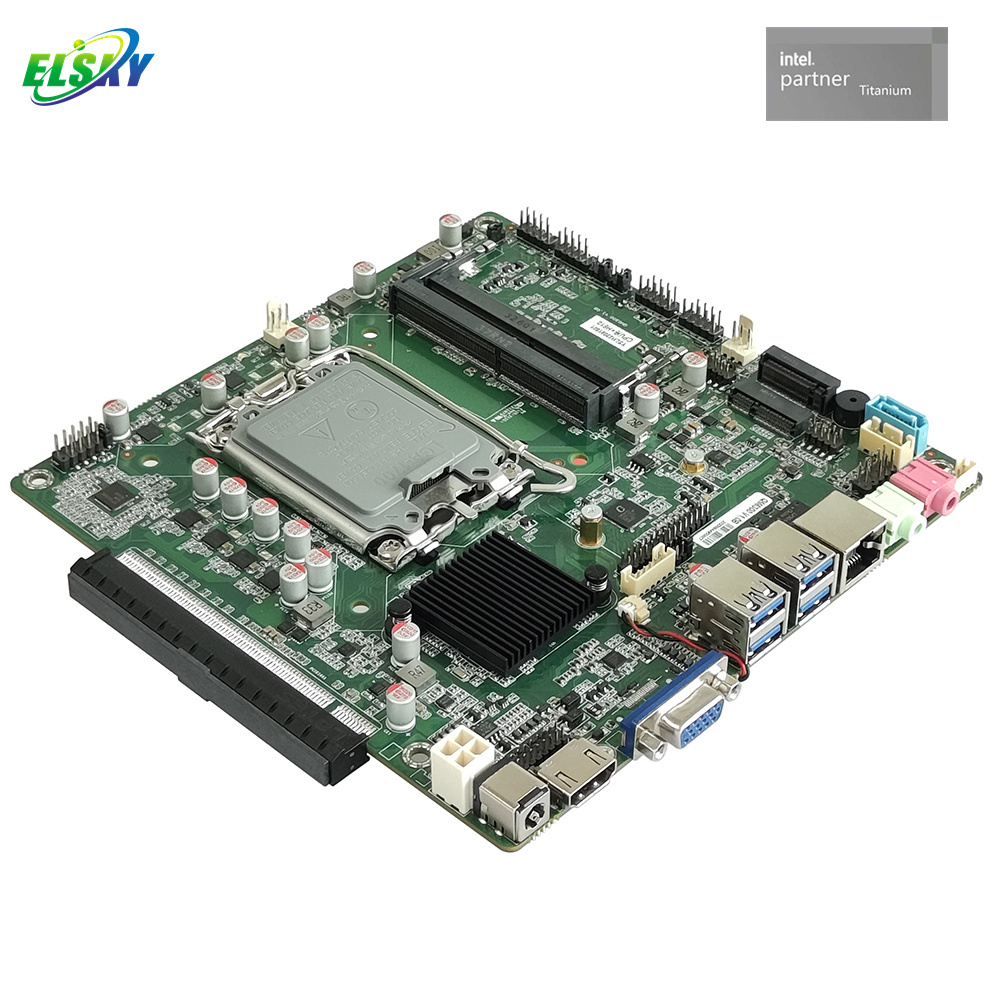
The trend toward miniaturization is undeniable. As computing power moves closer to the point of action—whether that is inside a smart vending machine, a robot arm, or a slim wall-mounted digital sign—the motherboard must shrink without sacrificing performance. The Mini-ITX motherboard (170mm x 170mm) has become the industry standard for compact yet powerful systems, offering a full PCIe slot and multiple storage options in a footprint a fraction the size of ATX boards.
Even smaller than Mini-ITX are the 3.5-inch and Nano-ITX boards. These motherboard variants are often used in fanless designs, where the board is mounted directly to a metal chassis that acts as a heat sink. This is critical for deployments in dusty or outdoor environments where moving parts like fans are prone to failure. Despite their size, these motherboard models often feature powerful mobile-class processors that can handle complex logic and multi-threaded applications.
The shift toward SFF motherboard designs also simplifies the B2B supply chain. Smaller boards require less packaging, cost less to ship, and allow for the design of smaller, more aesthetic end-products. As power density increases, we expect to see the motherboard of the future pack even more features—such as integrated Wi-Fi 6E and AI accelerators—directly into these diminutive footprints.
Space Efficiency: Fits into compact industrial enclosures and kiosks.
Reduced Power Consumption: Often utilizes mobile-optimized CPUs to lower energy costs.
Versatile Mounting: Supports VESA, DIN-rail, and customized mounting solutions.
Enhanced Durability: Simplified layouts often lead to better resistance against vibration.
To ensure 24/7 operational continuity, industrial motherboard designs utilize advanced thermal dissipation techniques and high-tolerance electronic components capable of withstanding extreme temperature fluctuations.
In an industrial setting, a motherboard failure is not just an inconvenience; it can result in thousands of dollars in lost production time. Therefore, reliability starts at the component level. Designers of a high-end motherboard select "Grade A" components, such as Japanese solid capacitors that are rated for 50,000+ hours of operation at high temperatures. This is a stark contrast to consumer boards, which may use lower-cost components that degrade quickly under constant heat.
Thermal management is the second pillar of motherboard reliability. Modern high-performance CPUs generate significant heat, which must be moved away from the motherboard efficiently. Future-focused boards utilize multi-zone thermal monitoring, where sensors placed around the VRM (Voltage Regulator Module) and chipset adjust system parameters in real-time to prevent overheating. Some motherboard designs even feature heat-pipe cooling systems that contact the chassis directly, eliminating the need for airflow.
Finally, environmental protection is becoming a standard feature for the industrial motherboard. Conformal coating—a thin chemical film applied to the PCB—protects the motherboard from moisture, dust, and chemical contaminants. This allows the motherboard to operate in oil-mist environments in CNC factories or humid conditions in agricultural monitoring stations, ensuring that the hardware survives as long as the machinery it controls.
The surge in AI-at-the-edge applications is driving a redesign of motherboard layouts to include dedicated M.2 slots for AI accelerators and improved power delivery for high-performance GPUs.
Artificial Intelligence is no longer confined to the data center. Today, the motherboard at the "edge" must be capable of processing neural networks for facial recognition, predictive maintenance, or autonomous navigation. This has led to the emergence of the "AI-Ready" motherboard, which features specific hardware optimizations like high-current power phases to support the sudden power draws of AI inference tasks.
One of the most significant changes is the inclusion of multiple M.2 expansion slots on the motherboard. These are no longer just for SSDs; they are increasingly used for AI acceleration modules (such as those using Google Coral or Intel Movidius technology). By placing these accelerators directly on the motherboard, latency is reduced compared to cloud-based processing, allowing for near-instantaneous decision-making in critical applications.
Furthermore, the physical I/O of the motherboard is adapting to AI needs. High-bandwidth camera interfaces, such as GMSL2 or multiple USB 3.2 Gen 2 ports, are being integrated directly into the motherboard to handle the massive data inflow from multiple high-definition sensors. This holistic approach ensures that the motherboard serves as a complete "brain" for intelligent machines, rather than just a general-purpose controller.
Future procurement strategies for motherboard technology will focus on hardware-level security, carbon footprint reduction, and the stability of the global semiconductor supply chain.
As cyber threats become more sophisticated, the motherboard is becoming the first line of defense. We are seeing a move toward integrating TPM 2.0 (Trusted Platform Module) and custom BIOS security features directly onto the motherboard. For B2B buyers, ensuring that a motherboard supports "Secure Boot" and hardware encryption is essential for protecting sensitive corporate data and preventing unauthorized firmware tampering.
Sustainability is also entering the motherboard conversation. Manufacturers are looking for ways to reduce the environmental impact of PCB production by using recycled materials and lead-free soldering processes. A future-ready motherboard is one that not only performs well but also meets strict environmental certifications like RoHS and REACH, which are increasingly required for government and large-enterprise contracts.
Finally, the concept of "Total Cost of Ownership" (TCO) is shifting how businesses select a motherboard. Rather than looking at the initial purchase price, procurement managers are evaluating the motherboard based on its energy efficiency, expected lifespan, and the ease of remote management (via technologies like IPMI or vPro). A high-quality motherboard that can be diagnosed and rebooted remotely saves significant costs in on-site technician visits, making it a much smarter investment in the long run.